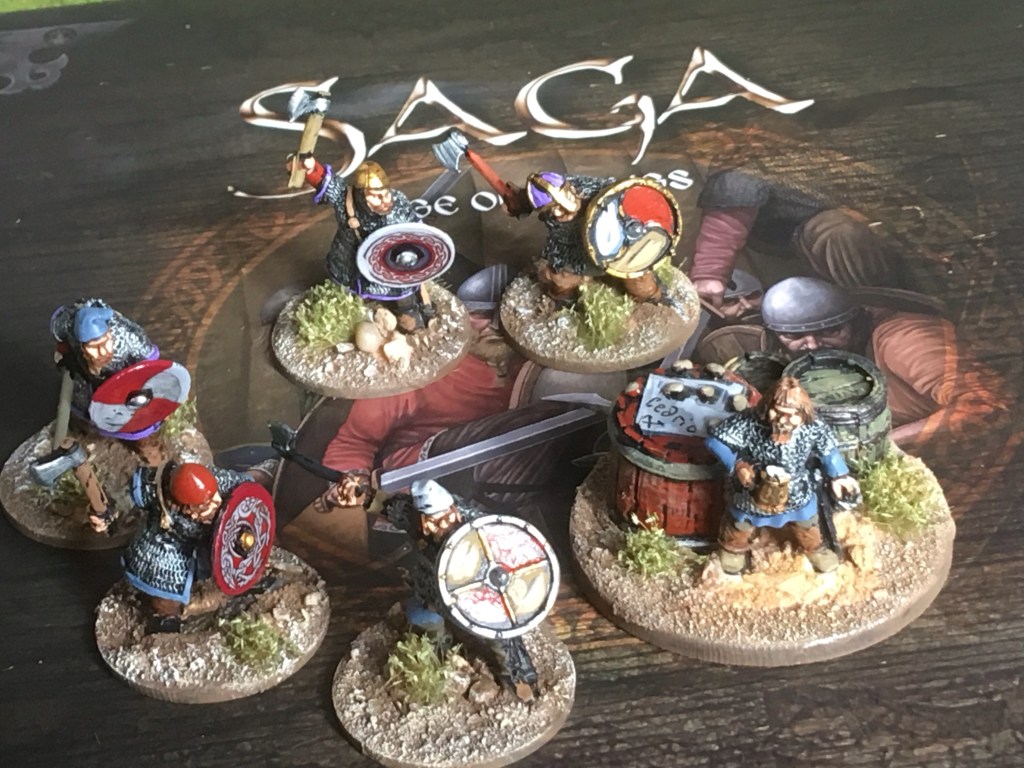
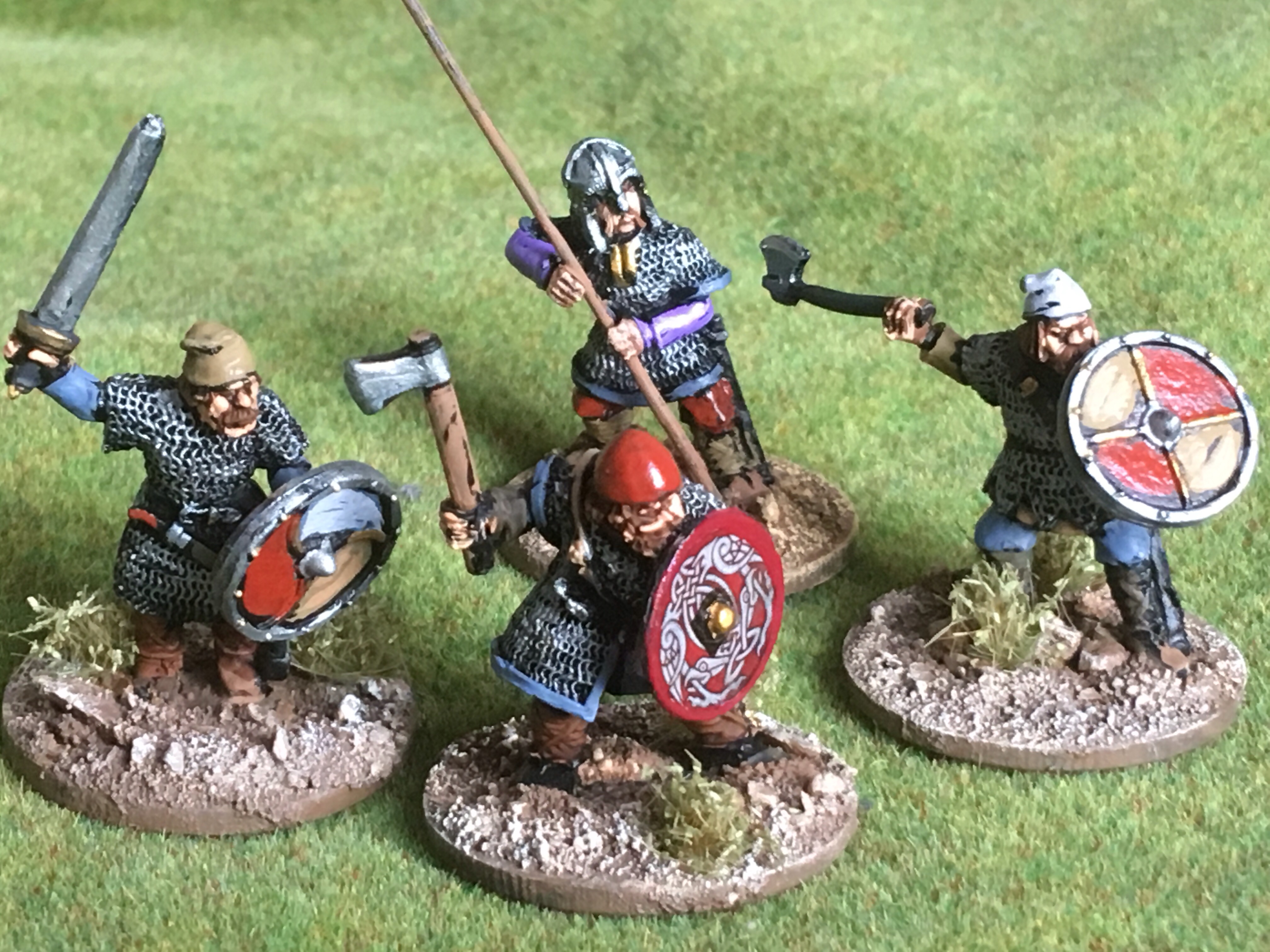
Those of you that know me (Uncle Ken) will not be surprised that I am a fan of skirmish style games, especially since I have put on participation games at several shows. Today I want to talk about a particular game, SAGA now in its second edition from Gripping Beast, has been a particular favourite for some time. Apart from the main rule book there are currently three books that cover a period roughly covering the Dark Ages as we know them up to an including the Crusades and a further book, The Age of Magic, and finally one more book, the Book of Battles the most innovative in the series. In this short series of articles I will introduce the Rules, the Book of Battles and two faction books, Age of Vikings and Aetius and Arthur followed by a short summary of The Age Of Crusades and The Age of Magic.
It is the darkest of times for the people of Europe and the British Isles, a time when the only rules seem to be that of the sword and the spear. An age when Warlords fought to rise above their rivals mustering their warbands to pillage, raid and burn, to win glory, riches and immortal fame in the ballads of the bards.

Warfare in the “Dark Ages” (or the early Medieval period as historians have now this time) was carried out on a smaller scale than most of us probably imagine. Often it was not the large set-piece battles we picture with Kings (like Arthur) directing their forces to victory. It was often shabbier, with local Warlords, who often styled themselves as Kings, greedy for profit in the forms of Cattle, Slaves and Gold. They would gather their bands of warriors and raid neighbours, burning down houses and killing anyone (Saxon or Briton) who got in their way. Once the alarm was raised the locals would gather with their weapons in an attempt to drive off the raiders before they could do too much damage. The cleric Gildas (a contemporary of this time) in his “On the Ruin of Britain” described them as tyrants who spend their time terrorising and robbing the innocent while protecting and promoting bandits.
Peter Marren in his book Battles of the Dark ages provides an excellent backdrop for this period, one that is well worth reading. At one point he poses the question, “what constitutes a battle?” and to answer this question directs us to the laws of King Ine (Eyne-na). These laws issued in about 690 describe them as follows: “An attack involving up to seven violent men was regarded as mere ‘thievery’. Between seven and thirty-five was classed as a ‘band’, but any number in excess of that was classed as a ‘here’ which can loosely be translated as an army. ”
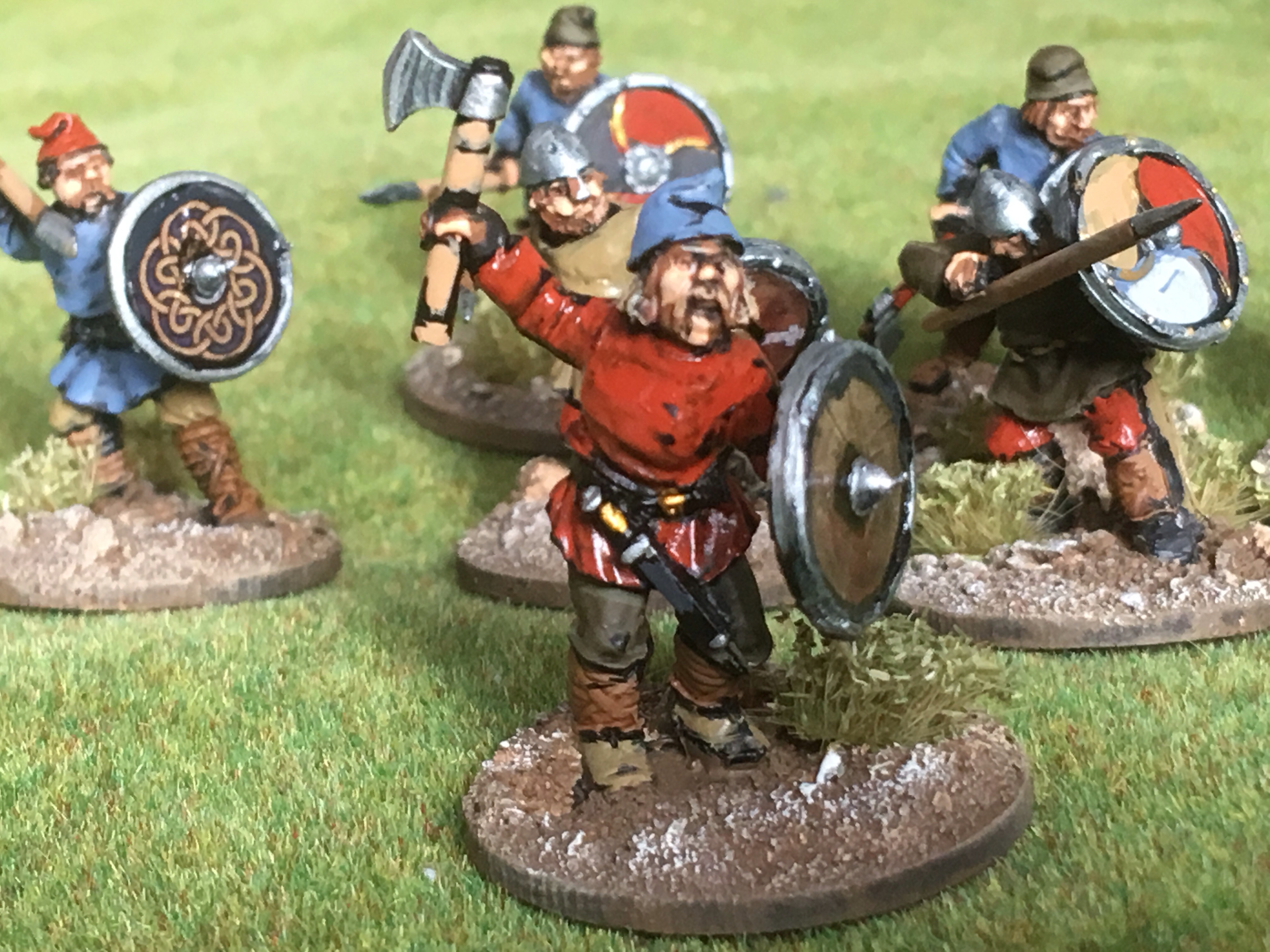
That places our SAGA forces which average just over 36 figures a side when fielding 6 points as two armies facing each other and at the very least a band if we are fielding a lower points value. How’s that for historical accuracy, it’s not often we can field a 1:1 ratio of troops in a historical game and still call it a “battle”.
So onto the rules, now in their second edition, they are well written and illustrated and one of the most enjoyable games currently available. The game normally played on a 4ft by 3ft area is where our two Warbands meet. A force (normally between 4 and 6 points) from your chosen faction, is normally made up of several different categories of warrior; First your Warlord, he comes free as every force will need one; then your Warlords personal house troops or Hearth-guard, these cost 1 point for 4 figures and as you would expect are your toughest fighters, then there are Warriors, freemen who have taken up arms to support their lord and cost 1 point for 8 figures; finally the levy, inexperienced troops who may be less well equipped than the others and these cost 1 point for 12 figures. A force may also take on a legendary hero, but these with points cost are covered in the additional rules for their appropriate faction in the SAGA Universe book.
A simple force of 4 points could have 4 Hearth-guard, 16 warriors and 12 Levy, led into action by your Warlord. These troops generate faction dice to be used on your Battle board, (more on Battle Boards later) normally one per unit (this can be restricted by losses to a unit) with additional dice for the Warlord. Units can be a minimum of 4 figures to a maximum of 12, so yes, our levy could be in two units of 6, or 2 points of Hearth-guard could form 1 unit of 8 figures. These faction dice generated by our units along with the Battle boards are at the core of the game.

Each faction has its own Battle board and associated faction dice, it is mastering these that is the key to success. I will try to keep it simple here and take a quick look at one faction the Vikings, when we look at the SAGA Universe books later there will be more. The Battle board (see below) has a banner across it with the name of the faction, this divides the board into two areas, the top row is intended for activations of units and any number of our SAGA dice are used here. We are only ever allowed a maximum of 8 SAGA dice in play at any time and the symbol in the area must correspond with the dice allocated to it Here you will see that the upper section of the board has 5 areas, Hirdmen (Hearth guards and heroes), Bondi (Warriors) and Thralls (Levies) a dice in any of these areas will allow you to activate that type of unit our Warlord also gets a free activation which he can transfer to a unit he commands providing it is within a short of him, the remaining two are self-explanatory. The bottom area of the board is for additional abilities that you may wish to assign to an activated unit, but only one of each activity can be used in a turn. If you are able to use LOKI for example, you gain 2 attack dice each time the enemy unit triggers a SAGA ability or uses one of your fatigues. Activating a unit more than once in a turn or engaging in combat generates fatigue which can be used against you at your opponent’s discretion, either to modify armour values when defending or to restrict your movement.
There is a single scenario at the end of the rulebook (Clash of Warlords) to provide a starting point for your adventures.
There are some interesting demonstrations on SAGA THORSDAY, Youtube at https://www.youtube.com/watch?v=b2aGqUbHWhA
Next time, I will introduce you to The Book Of Battles, one of my all-time favourite books.
Uncle Ken



 Despertaferres
Leave a comment